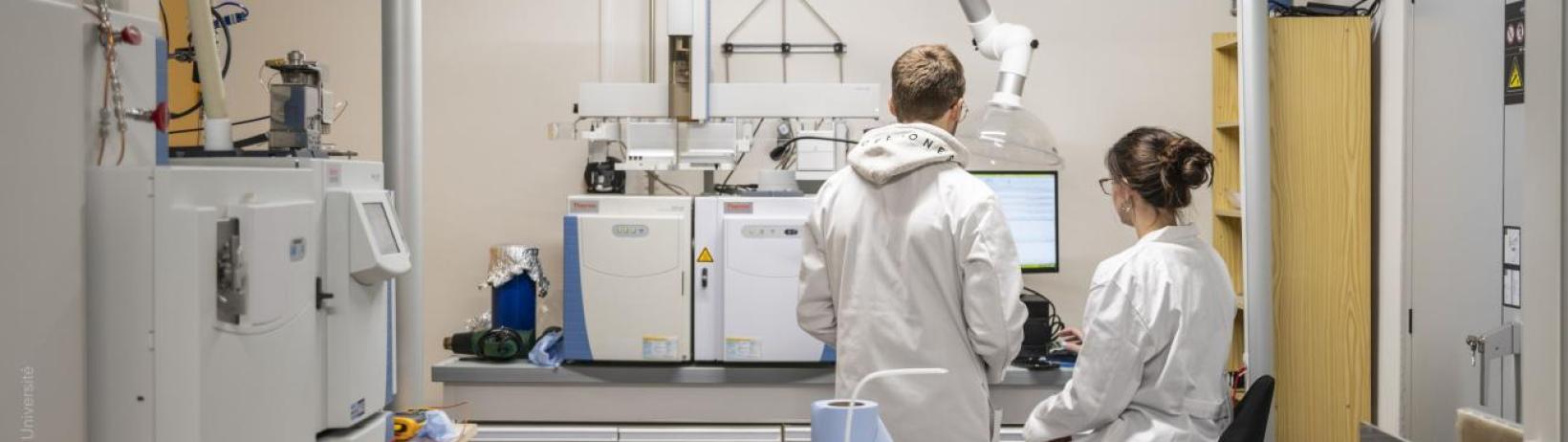
The Origines Institute’s doctoral program consists of 6 modules and involves 6 laboratories: LAM, CEREGE, PIIM, IMM, IGS, and MIO.
Students come primarily from four doctoral schools: ED 62, ED 250, ED 251, and ED 352.
Students can enroll in the entire program (24 hours) or just a portion of it (one or more of the six modules offered) through their ADUM account.
Course Description: The Origines Institute is an organization within Aix-Marseille University whose goal is to establish a center of excellence in research and education focused on an interdisciplinary theme: astrobiology. These courses, offered as part of AMU’s doctoral program, are designed to provide students with an overview of the various aspects of this interdisciplinary science.
Locations: Research laboratories (LAM, CEREGE, PIIM, IGS, BIP)
Language: English
Description: The program is organized into five modules. Students may choose to take individual modules or the entire program
The 6 course modules offered:
Instructors: Vincent Hue (vincent.hue@lam.fr) & Pierre Vernazza (pierre.vernazza@lam.fr)
Location: LAM
Duration: 2 x 2.5 hours
Date: Tuesday 9 March 2027
Objectives: Provide an overview of the material present in the early solar system, atmospheres, and their evolution over the past 4.6 billion years.
Program: Review of major ground-based surveys and recent space missions to small bodies, particularly sample-return missions. Introduction to meteorites, their classification, observation, and flux into Earth’s atmosphere.
Instructors: Yoann Quesnel (quesnel@cerege.fr) & Bertrand Devouard (devouard@cerege.fr)
Location: CEREGE
Duration: 2 x 2.5 hours
Date: Tuesday 2 February 2027
Objectives: Understand the role of planetary magnetospheres and impact processes in the emergence, maintenance, and/or destruction of life.
Program: Introduction to the magnetospheres of terrestrial and giant planets, and their impact on habitability. Understand the interaction between the Galilean moons and Jupiter’s magnetic field. Introduction to the formation of impact craters on Earth and other planets, their consequences, and impact products.
Instructors: Benedicte Burlat (benedicte.burlat@imm.cnrs.fr) and Simon Duval (sduval@imm.cnrs.fr)
Location: BIP
Duration: 2.5 hours
Date: Tuesday 9 February 2027
Objectives: Discover the role of metals in the emergence of life on Earth and its evolution.
Program: The role of metals in prebiotic chemistry (catalysis of early abiotic reactions) and their importance in providing free energy for the emergence of life.
Instructors: Vincent Hue (vincent.hue@lam.fr) & Laurent Lamy (laurent.lamy@lam.fr)
Location: LAM
Duration: 2 x 2.5 hours
Date: Friday 26 February 2027
Objectives: To be announced
Program: To be published soon
Teachers: Nathan Hara (nathan.hara@lam.fr) & Sophia Sulis (sophia.sulis@lam.fr)
Location: LAM
Duration: 2 x 2.5 hours
Date: Thursday 11 March 2027
Objectives: Learn about extrasolar planets, how to detect them, and the search for signs of life on these planets.
Program: Review of detection and analysis techniques for exoplanetary systems. Exoplanet demographics and conditions for habitability.
Instructors: C. Abergel (chantal.abergel@igs.cnrs-mrs.fr), G. Erauso (gael.erauso@mio.osupytheas.fr)
Location: IGS
Duration: 2 x 2.5 hours
Date: Tuesday 16 March 2027
Objectives: Become familiar with the most extreme forms of life on Earth and possible scenarios for the emergence of cellular life on Earth and possibly on other planets.
Program: Presentation of extremophilic prokaryotes (bacteria and archaea), viruses, viroids, and prions.