Instrumental and Technological Platform of the Origins Institute for Training through Research (PITIO-FR)
Training and Research Interdisciplinary Platform (TRIP) of the Institut ORIGINES, from planets to life.
Co-funded by the France 2030 program and the Aix-Marseille Excellence Initiative
Spearheaded by the Institut Origines under the direction of Grégoire Danger, the PITIO-FR project aims to train students through and for research by offering them unique access to a platform bringing together cutting-edge instruments and techniques.
The Institut Origines, an interdisciplinary structure, explores the processes at the origin of planetary systems, the minimum conditions for life on Earth, and the impact of environmental variations on evolution. It offers students (bachelor's, master's, doctorate) practical training in astrophysics, chemistry and biology, through projects linked to its themes and economic collaborations.
The platform brings together a wide range of tools: astronomical detection, mineral analysis, research and characterization of organic molecules, microscopy and spectroscopy. It enables students to acquire interdisciplinary and technological skills that are highly valued by the business world.
The aim of PITIO-FR is to reinforce this dynamic by promoting exchanges with industrial partners and cultivating open-mindedness through interdisciplinarity.
> INSCRIPTION 2026-2027 <
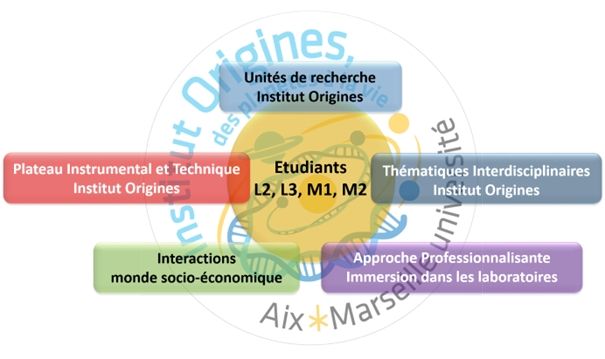
The PITIO-FR project offers Aix Marseille Université students practical training in advanced observation and analysis techniques, shared within the Institut Origines technical platform.
With access to cutting-edge equipment often unavailable in their home departments, students will work in an immersive research environment. They will interact directly with technical staff, PhD students, researchers and teacher-researchers, and work on projects linked to ongoing research.
This experience will enable students to familiarize themselves with the tools they will use in their future careers (internships, fixed-term or permanent contracts), and to acquire technical and interdisciplinary skills that are particularly valued by the business world.
Proposed projects
> INSCRIPTION 2026-2027 <
Study various aspects of the role of meteorite impacts on the origin of life
Asteroids, formed from the solids and primitive organic matter of the protosolar disk, are considered to be the remnants of the Training of telluric planets like the Earth. On our planet, fragments of asteroids, known as meteorites, reach us for detailed analysis. This project focuses on a particular class of meteorites, those rich in organic matter: carbonaceous chondrites.
These carbonaceous chondrites show, through their mineralogy, traces of a process that took place on their parent asteroid over 4 billion years ago, known as aqueous alteration. During this alteration, organic matter evolved alongside the mineral phase. The project focuses in particular on the simultaneous alteration of both phases (organic and mineral), seeking to understand how it may have influenced the present-day composition of carbonaceous chondrites.
This project, proposed by the PIIM, CEREGE and LCE laboratories at Aix Marseille Université, aims to retrace the origins of our solar system by analyzing extraterrestrial samples such as meteorites, and developing laboratory experiments to simulate the formation pathways of these objects.
Understanding the emergence of life is one of the most exciting and complex questions in science. Most research focuses either on the Training of organic molecules, or on the mechanisms that provide the energy necessary for the emergence of life. Our project takes a unique interdisciplinary approach by combining these two perspectives. We propose that minerals present in alkaline hydrothermal vents (AHFs) may have created the organic molecules essential to life using an energy-producing mechanism common to living organisms, known as chemosmosis, which generates the necessary free energy.
At BIP, in collaboration with PIIM, we have developed mineral membranes that mimic the chemical conditions of AMPs in order to study both the formation of organic molecules and the process of chemosmosis. During the internship, students will work at the interface of mineralogy and chemistry, using tools from biology and physics to explore these fascinating processes.
Some of the moons of Jupiter and Saturn harbor oceans of liquid water beneath their surfaces. The Origins Institute is investigating the possibility that these oceans could harbor life forms, and that they could be detected by space probes. These studies include the cultivation of extremophilic micro-organisms in conditions representing these oceans, analysis of the chemical signatures of these organisms, modeling of the evolution of volatiles in the ocean, and laboratory experimentation on the evolution of signatures on the surface of ice moons (under irradiation). This work is being carried out in conjunction with space missions to ice moons in the solar system (European Space Agency's JUICE, NASA's Europa Clipper).
During the impact or atmospheric explosion of small asteroids on Earth, part of the Earth's surface may be vitrified or even ejected several hundred kilometers from the impact zone (this is known as tektite). The study of these impact glasses provides us with information on the physico-chemical conditions at the time of impact, but also on the frequency of these past catastrophic events, which sometimes left no other traces such as impact craters.
The aim of the proposed project is to study various samples of natural glass, in order to determine the criteria for recognizing impact glass and determining its Training mechanisms. The techniques used will include optical and electron microscopy, chemical micro-analysis, IR and Raman spectrometry, etc.
Laboratories involved include CEREGE, PIIM and CINaM (list not necessarily exhaustive).
This subject will offer at least one M2 internship in 2025, but may also be open to L2 or L3 projects as early as 2024-2025.
Titan, Saturn's largest satellite, is the only one in the solar system to have a dense atmosphere (1.5 bar) composed mainly of nitrogen and a few percent methane. Subjected to various sources of irradiation, this atmosphere is a highly reactive medium, evolving through molecular growth and the ongoing production of aerosols. Among the molecules formed, hydrocarbons (C6H6, C4H2...) and nitriles (C2H3CN, HCN...) are known to condense in the lower stratosphere and lead to the training of icy particles. During their stay in the lower atmosphere (stratosphere and troposphere), these particles are then exposed to radiation at wavelengths above 230 nm, and can evolve chemically.
The aim of this project is to study the aging of ices formed in Titan's lower stratosphere, either pure or adsorbed on the surface of aerosol analogues in Titan's upper atmosphere.
Le projet portera sur l’échantillonnage microbiologique, physique et chimique de
l’atmosphère pour aborder les mécanismes de dissémination de la vie par les voies aériennes.
Objectifs :
- Faire un état des lieux des méthodes de collecte disponibles par domaine
- Budgétiser les différentes méthodes
- Identifier la/les stratégie(s) de collecte la/les plus adaptée(s) au projet
- Identifier et contacter les laboratoires partenaires
- Obtenir un financement
- Résoudre les verrous techniques
- Mener la collecte
- Analyser (ou faire analyser) les données
Au moins une partie des analyses des échantillons pourra être menée au sein du plateau
technique de l’institut qui agrège un grand nombre d’instruments expérimentaux et un savoir-
faire technique et technologique.
Students 2024-2025
| Nom | Prénom | Filière | Niveau | Projet scientifique sélectionné | Porteur projet | Laboratoire d'accueil |
| Mertens | Hugo | M2 STPE branche IMG | M2 | Formation des tectites et verres d’impact météoritiques | Devouard | CEREGE |
| CLOUET | Adriana | Biochimie structurale | M2 | Mineral at the origin of Life | Duval | BIP |
| Seixas Gomes Ferreira | Madison | SVT spécialité Terre | L3 | Astrobiologie des lunes de glaces | Bouquet | PIIM |
| AZAR | MARTIN | SBG (Sciences biologiques et géologiques) | L3 | Formation des tectites et verres d’impact météoritiques | Devouard | CEREGE |
| Gouilloux | Hugo | M2 STPE IMG | M2 | Formation des tectites et verres d’impact météoritiques | Rochette | CEREGE |
| Pierrès | Joline | Sciences de la terre | L3 | ORGAMISS/Mineral at the origin of Life | Duval | BIP |
| Valat | Solène | Chimie | M1 | TITAN | Couturier | PIIM |
| Mathieu | Faustin | Chimie | M2 | TITAN | Couturier | PIIM |
| Block | Jason | Chimie | M2 | Origine du système solaire à travers les météorites et leurs analogues | Danger | PIIM |
| Bharindwal | Sahaj | Bio | M2 | Astrobiologie des lunes de glaces | Erauso | MIO |
Students 2024-2025
| Nom | Prénom | Filière | Niveau | Projet scientifique sélectionné | Porteur projet | Laboratoire d'accueil |
| Mertens | Hugo | M2 STPE branche IMG | M2 | Formation des tectites et verres d’impact météoritiques | Devouard | CEREGE |
| CLOUET | Adriana | Biochimie structurale | M2 | Mineral at the origin of Life | Duval | BIP |
| Seixas Gomes Ferreira | Madison | SVT spécialité Terre | L3 | Astrobiologie des lunes de glaces | Bouquet | PIIM |
| AZAR | MARTIN | SBG (Sciences biologiques et géologiques) | L3 | Formation des tectites et verres d’impact météoritiques | Devouard | CEREGE |
| Gouilloux | Hugo | M2 STPE IMG | M2 | Formation des tectites et verres d’impact météoritiques | Rochette | CEREGE |
| Pierrès | Joline | Sciences de la terre | L3 | ORGAMISS/Mineral at the origin of Life | Duval | BIP |
| Valat | Solène | Chimie | M1 | TITAN | Couturier | PIIM |
| Mathieu | Faustin | Chimie | M2 | TITAN | Couturier | PIIM |
| Block | Jason | Chimie | M2 | Origine du système solaire à travers les météorites et leurs analogues | Danger | PIIM |
| Bharindwal | Sahaj | Bio | M2 | Astrobiologie des lunes de glaces | Erauso | MIO |